
What Does It Really Mean to “Be Yourself”?

Written by Dylan Smith
Thumbnail and Banner Photo by Noah Buscher on Unsplash
Just Be Yourself
If, like me, you were born after the year 2000, you’ve probably been told to “be yourself” over and over again since the day you entered preschool. The problem with this ubiquitous little chestnut is that it is, essentially, meaningless. After all, we have no choice but to be ourselves; we can’t simply step into someone else’s brain, and even if we could, wouldn’t we still essentially be the people we already were? Despite this, we often paradoxically feel that we are not being ourselves. Maybe some part of our appearance isn’t quite true to how we see ourselves, or maybe we find ourselves acting or speaking in a way we don’t think we should. Someone may respond to this by saying, “Being yourself just means doing whatever you want, regardless of what others think.” However, we often feel that what we want isn’t what we really ought to do if we are true to ourselves (consider, for example, smoking or doomscrolling, or any other such nasty habit). Furthermore, our true selves often care intensely about how others feel about our actions; it’s only natural as a human being to want to make others happy and to impress the people we respect.
So if you know what it’s like to not be yourself, why is it often so hard to pin down what it means to actually be yourself? Is your “self” even real? Can you ever know what it really is, and can you ever really be true to it.
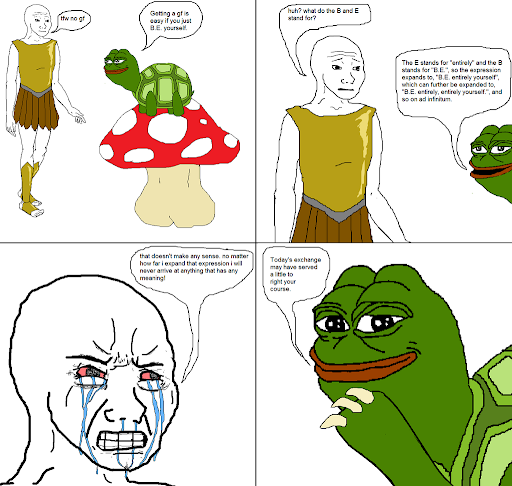
Image by Anonymous
What About You Is “You”?
When we talk about being yourself, we are usually referring to personality. However, personality can be a rather tricky topic. What some may consider to be personality, a person’s way of speaking and relating to others, their habits, their aesthetic preferences, et cetera, are really just a superficial manifestation of the deeper elements of their true personality. In psychology, we typically consider a person’s fundamental personality to be those elements of their character that are relatively persistent over the course of their life, which account for a large degree of variation in those more superficial qualities, and which can be used to predict how the given individual will act in the future (more on this later). The five most important personality traits in this regard are our relative degrees of extraversion, openness to new experiences, neuroticism, agreeableness, and conscientiousness; everyone possesses these traits or their opposites to a greater or lesser degree. Most other personality traits are considered to be sub-traits of one of these. So what does this mean for our more specific tendencies – our sense of humour, our political stances, or our favourite movies? Chances are, they will change across time, and different tendencies in this regard are typically linked to one of those “Big Five” traits. This doesn’t mean that they aren’t real, just that they aren’t the true essence of who you are (from the psychological perspective, at least).
So why do we sometimes act out of character? Does our personality sometimes leave us? Yes and no. Personality influences how we behave, but it is more predictive of aggregate behaviour than of specific behaviour. For example, if your particular personality predisposes you to prefer spicy foods to mild foods, I can reasonably expect that out of 100 opportunities to choose between spicy and mild foods, you will choose the spicy option at least 51 times. However, if you and I sat down to eat in the same restaurant, even with an extensive battery of personality tests at my disposal, it would be exceptionally difficult— arguably impossible— for me to guess which menu item you will order. This is because, in this scenario, your preference for spicy foods is not the only thing influencing your choice. Your decision may change depending on the time of day, the restaurant’s reputation for exceptionally spicy food, or the context in which we are meeting before you order. For this reason, our specific behaviours are not always representative of our usual tendencies.
Some situations can influence your behaviour more than others. For example, a casual meeting with a group of old friends is a rather permissive setting, in which you are very free to act naturally, but a graduation ceremony is a highly prescriptive setting in which your behaviour is more likely to conform to the expectations of others. We likely overestimate how much we act out of character because we are a bad judge of how often others do so. You have likely, at some point in your life, found yourself in a strange setting where you did not know how to act, such as perusing an art gallery or attending your first university lecture. You probably looked around the room at the other people there to get some sense of how you should behave. The thing is, everyone else in that room was probably doing just the same thing, except they were looking at you to know how to act. From your perspective, everyone was acting totally naturally except for you.
Reducing personality to a series of statistics and probabilities may seem rather depressing. After all, our generation has been constantly reassured that each one of us is totally unlike everyone else on Earth. In a sense, this is true. Your particular personality is what a psychologist (or a German) might call a gestalt, something that is reducible to separate parts (like personality traits) but which, in totality, has qualities none of its individual parts possess. Imagine a particular trait that you have, which we will call “x”. Now imagine a hypothetical person whose traits are identical to yours, except that they are missing x. This person’s personality, the particular way that they interact with the world, is not equal to “you - x,” but is rather an entirely unique personality which may not even resemble yours in any meaningful way. This is why you really are special , even though there are thousands of people whose traits are almost (but not perfectly) identical to yours. You are more than the sum of your parts. You are unique, even if the parts that make you up are not.
What Makes You Who You Are?
You may have heard of the “nature vs. nurture debate”, which concerns whether people are who they are on account of biology (nature) or on account of their environment (nurture). You may even subscribe to one side of this debate. If you do, you are wrong, regardless of which side you picked; virtually every human trait which can be measured, including the elements of personality, is influenced both by genetics and environmental factors to a greater or lesser degree. Who you are, your exact assemblage of personal traits, is the result of a literally incalculable number of influences on your life, both biological and sociological. You may have sometimes wondered, “What if I were born in a different country?” or “What if my dad were Usain Bolt?” This is a silly question, because “you” could not have been born or raised under any circumstances except those that you were. The gestalt that is “you” would not meaningfully resemble you if any single one of its parts were different, and those parts would inevitably be different if even one event in your life did not occur in precisely the way it did.
Furthermore, our experience of our environment does not only begin to influence us once it crystallises into a memory. As stated above, our environment in the present moment– our particular situation– also changes the way we think and act, and in that sense makes us a different person. In this way, you are a different person every moment, and who that person is is shaped by a myriad of factors, biological and psychological, which are present in exactly that moment. You may have heard someone say that “anything you would do drunk, you would do sober.” This is patently untrue. Drunk-you possesses a different biological makeup and social situation from sober-you. Because of this, drunk-you is a fundamentally different, albeit similar, person to sober-you, and drunk-you’s personality is only distantly related to that of sober-you.
We tend to have some notion that who we are is static, and that it takes some truly life-changing event to alter who we are. That is not the case. Who we are is constantly changing, and we ought to embrace that change rather than living in denial of it.
Is Your Self Actually Real?
You may have some sense that all of this stuff that makes you “you” is part of a unique, individual mind located somewhere within your body, and that “you” have been this individual mind since you gained sentience sometime around age three. This seems to be a rather intuitive conclusion to draw from our experience of the world, but there are some problems with this. Your mind, the presumed seat of your self, is not entirely separate from your body, which somewhat complicates the notion that “you” are within your body, rather than being the body itself. Even things which you may consider very personal and unique to you, such as your opinions and feelings towards particular things, can be influenced by the state of your body in the moment that you experience them. These effects are often subtle, but nonetheless may affect even the highest faculties of your mind.
If you are, alternatively, of the opinion that you are entirely your body, and that your brain has no special status among your various organs, you will inevitably come upon the issue that your brain is certainly not the one you were born with, and thus “you” cannot be the same “you” you were when you were born. Your brain undergoes physical changes across the entire course of your life, so if it really does contain the true essence of your self, your self must also constantly change. However, the mass of cells making up your brain is obviously not the most significant part of your identity. If you hypothetically switched off your brain, the essence of who you are would disappear; it is the activity of your brain that makes up who you are. However, the exact configuration of electrical potentials contained within your brain cells is constantly changing. The nature of mental activity is the motion of electrical impulses, not stasis. If what makes up a mind is its activity, then your mind now can hardly be considered the same as your mind from three seconds ago, let alone from three years ago. Even your memory of past minds changes from one moment to the next, creating the illusion that your thoughts now are much more similar to those past than they really are. It is possible that your personality is substantially different now than it was yesterday, and you would never know unless someone else told you. Integration across time, the sense that the “you” now is the same as the “you” from one minute ago, is essentially an illusion.
Furthermore, the elements of your personality– who or what you typically perceive yourself to be– do not entirely originate with you, and therefore cannot reasonably be considered meaningfully separate from the rest of the world. Not only are your feelings in any single moment strongly influenced by the state of your body, but your overall patterns of thinking and behaviour are affected by your environment in a profound and subconscious way. To borrow a term from Thich Nhat Hanh, your personality “inter-is” with everything you have ever interacted with.
So, is “yourself” actually a real thing? Not in the sense you probably think. We typically think of real things as being those which are persistent and have clearly-defined traits and boundaries. For example, the device on which you are reading this article has some such boundaries and traits. A not-real thing in this respect would be something like your name, since it really only continues to be your name as long as you believe that it belongs to you. But what would happen to those real things if you changed their boundaries and traits? For example, If you disassembled your phone, would it still be your phone, or would it simply be a pile of parts which may or may not be yours? In this respect, you are real insofar as your phone is real. The particular traits which it exhibits in its present form are real, but its nature is ephemeral; it only possesses its particular nature in the present moment because of the particular circumstances of existence as a whole. Given enough time, it will cease to even meaningfully resemble its identity in the present moment.

So What?
Unfortunately, this article is not going to leave you with some life-changing wisdom about what it means to be yourself, because, fundamentally, there is no such thing as being yourself. Or rather, there is no such thing as not being yourself, and therefore agonising over how to best be yourself is essentially pointless. In a sense, you are never yourself, because your “self” doesn’t really exist; we invent the idea of our “self” in every conscious moment. For that same reason, we can really never be anyone but ourselves, because whoever it is we find ourselves being in any moment is our truest self.
The good news is that, whoever you may be, you have the capacity to be happy with who you are. Worrying about whether or not we are really being ourselves is part of what prevents us from being truly happy. We think that we need to become ourselves, and so constantly imagine tension between our present self and our hypothetical future self. This is, as I say, imaginary. In reality, there is no tension. Who you are in the present moment is your true self— the truest self you have ever been or ever will be. If you only take away one thing from this article, let it be that appearances and affectations aren’t who you really are, and the only way to “be yourself” is to be present in your life and act naturally in accordance with it.
Make no mistake, it takes courage and compassion to accept this; oftentimes, we do not like the person we are in the present moment, and we find it hard to accept that it is our true self. We often make the mistake of thinking that being kind to ourselves means focusing on our best qualities and ignoring or downplaying our worst ones. However, this isn’t true kindness. Truly being kind to yourself means accepting your flaws. This doesn’t mean we have to be trapped by our shortcomings, but rather it empowers us to act compassionately toward ourselves, and to extend that compassion to others.