
Graceland and the Meaning of Life
Written by Dylan Smith
Banner and thumbnail photo by JR Harris on Unsplash
“My name is Ozymandias, King of Kings;
Look on my Works, ye Mighty, and despair!”
— Percy Bysshe Shelley, Ozymandias
Earlier this year, some of my buddies and I went on a trip down south that brought us to Memphis, Tennessee. While we were there, we decided to visit Graceland. If you don’t know what Graceland is, it’s a museum built around the house of Elvis Presley, and if you don’t know who Elvis Presley is, let me be the first member of the human race to welcome you to Earth. Elvis is likely one of the most famous people to ever live, right up there with Jesus and Barack Obama, and is sometimes described as the “world’s first celebrity”. Say what you will about him – that his music was all copied, that he never wrote a single song himself, that he was a lousy actor – sure; granted. But you certainly don’t see any Bruce Springsteen impersonators lining the Las Vegas strip. Though the “world’s first celebrity” is a bit of a dubious honour, seeing as how the United States (to say nothing of the world at large) has since come to revolve around not just celebrities but the very notion of celebrity itself.
Lamentations for society aside, I’ve always been fascinated by Elvis, though I don’t think I really knew why until I visited Graceland. Elvis is one of modern history’s most fascinating figures: a big, bold silver streak on the ledger of music history– a fissure in the fabric of pop culture that split the status quo and spewed forth a new genre, a new style, an entirely new attitude. However, it is strange that, for all the compelling elements of the Elvis mythos– the clothes, the cars, the controversy– Elvis himself is not one of them. Elvis’ image still captures the imaginations of Americans to this day, but Elvis himself, the man underneath the white polyester jumpsuit, seems to fade into the background of a legend that should, by all rights, belong to him. Elvis is a background character in his own story.
Let me paint you a picture. The guys and I have just spent the day driving to Tennessee from Mammoth Cave National Park, making a pitstop at the Bass Pro pyramid on the way into town (a monument to excess deserving of its own analysis, but I digress). Memphis isn’t exactly a nice town. The buildings are run-down, the roads aren’t maintained; the poverty rate here is 22%, 10 points higher than the nation at large. Graceland sticks out like a sore thumb– a tiny Disneyland right in the middle of the city. In addition to the house itself (which is nothing to shake a stick at), Graceland features a museum, a resort, no fewer than eight restaurants, and, by my estimate, about a dozen gift shops. Our party pays a frankly extortionate price for the house tour and entry to the museum. Before the tour can properly begin, we’re ushered into a little theatre where we’re shown a video hyping up the rest of the museum. It outlines the highlights of Elvis’ life: the #1s, the platinum records, and the movies no one cares about. At first, I think it’s a little strange, but by the end of the presentation, I realize that it’s actually much stranger than that. The whole video seems to be avoiding the topic of Elvis’ passing. It’s a little surreal; if you really had never heard of Elvis, and you had accompanied me into that theatre, you’d be forgiven for thinking that he was still alive and performing five nights a week in Las Vegas.
After the presentation, we’re herded onto a shuttle that takes us across the road to the house itself. It would have been barely a five-minute walk, but given that Memphis in August feels slightly hotter than the surface of the sun, I don’t mind being chauffeured around in an air-conditioned bus. Elvis’ house is actually surprisingly modest; it certainly puts modern celebrity mansions in perspective. The interior, however, is more commensurate with the Elvis legend, featuring pearly-white upholstery, baroque furnishings, and stained-glass ornamentation. Many interior design choices seem to defy explanation, such as the three TVs side-by-side in the den, the mirrors on the ceiling, the wraparound drapery in a game room with no windows, or the admittedly rather groovy tiki-themed living room. A plaque in the music room explains that he had the entire house redecorated every few years; the version preserved for posterity is from sometime in the mid-70s. It paints a somewhat peculiar picture: one of a man totally convinced of the American dream but never really sure what it was. Elvis believed in his own legend, but never really believed that he was living it. It’s at the very end of the house tour that we find the pièce de résistance, where we come face-to-face with the man himself: Elvis’ grave. It’s here that I finally put it together, why I find Elvis so fascinating. It’s so deceptively simple, I’m surprised I didn’t realize it before: Elvis is dead.
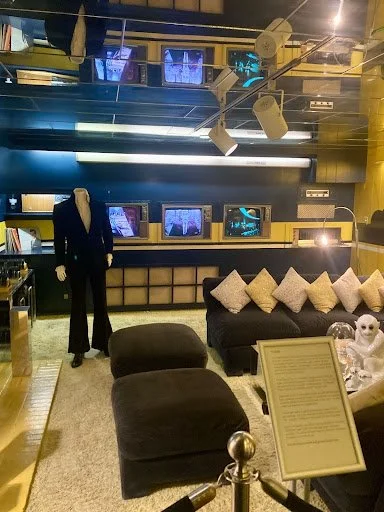
Photo by Dylan Smith
Elvis’ life wasn’t quite as glamorous as Graceland makes it out to be. Being Elvis wasn’t easy; the King endured a grueling performance schedule imposed upon him by his manager, Colonel Tom Parker, often considered the “villain” of the Elvis story. A notorious and fatally unlucky gambler, Parker condemned Elvis to a laborious performing contract at a Las Vegas casino (two shows a night, seven nights a week at its peak) in order to repay his extensive losses. Parker was also largely responsible for Elvis’s infamously bad film appearances, which neither he nor the audiences of America were especially pleased with. In 1973, Elvis and the love of his life, Priscilla, got divorced. Although the two remained on good terms, it was a major blow to his mental health. Elvis’ isolation and exhaustion sent him into a downward spiral of depression, anxiety, overeating, and drug dependency. By the end of his life, the King was miserable, paranoid, obese, and addicted to just about every type of prescription medication available to a man of means in the 1970s. Finally, on August 16th, 1977, his lifestyle caught up to him, and the world’s first celebrity died sad, sick, and perhaps worst of all, alone.
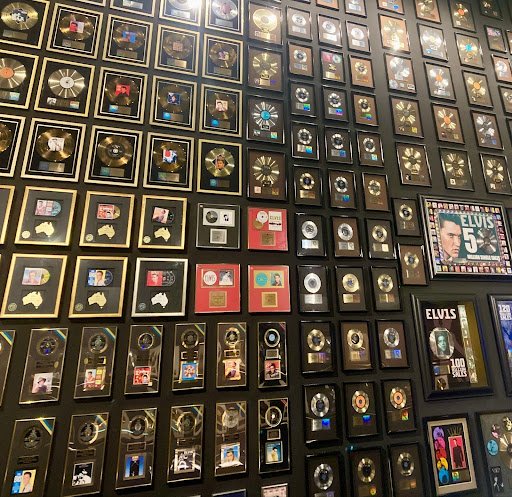
Photo by Dylan Smith
Ironically, Graceland completely misses the point of Elvis’ life. The compelling part of the Elvis story isn’t that Elvis was the most fabulous person on Earth; it’s that Elvis was the most fabulous person on Earth, and now he’s dead. Elvis’ palace is now little more than a roadside attraction, his opulent robes and glistening jewels no more than curiosities. His music, image, and legend now belong as much to the collective unconscious as they ever did to the man himself. Elvis had everything he could ever possibly want, and now everything he could ever possibly want is on display for my viewing pleasure. In that sense, it’s more mine than his. To the philosophical eye, Graceland is an object lesson in the absurdity of accumulating wealth. Elvis had more than I ever will. He was the first of the most privileged class in American society, but it never satisfied him. A dozen luxury cars weren’t enough. A hundred white jumpsuits– each one more expensive than my entire wardrobe– weren’t enough. One comically tacky home renovation wasn’t enough. He kept acquiring more and more until the day he died, and you know what? He was right. It wasn’t enough. It wasn’t enough to save him from misery. It wasn’t enough to save him from death.
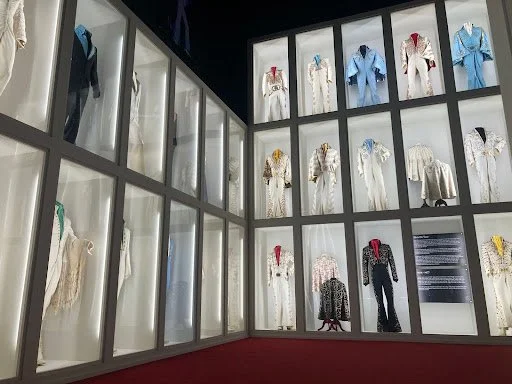
Photo by Dylan Smith
Graceland confronts its visitors with an uncomfortable truth that many of us lack the appropriate scope to truly appreciate: that material things will never satisfy us, and we can’t even take them with us when we go. Many of us spend our lives chasing wealth and material comforts. We tell ourselves that once we have our dream house, our dream car, and our dream indoor pool, then we’ll be all set for the rest of our lives. We believe that happiness lies on the other side of a winning lottery ticket. We think this because so few of us have ever actually seen the other side. Elvis had a winning ticket in his own way. He came from a family of poor “white trash” and, by the grace of God, became so rich and famous they invented a new category of rich-and-famous-ness just for him, but it didn’t make him happy. At the end of his life, what Elvis wanted more than anything else wasn’t another car or a bigger house; it was someone to talk to. You may think that my account here of Elvis’ life is extremely pessimistic, but I don’t see it that way. I think there’s an important lesson to learn from all this: that the only way to be satisfied is to be satisfied. Our lives aren’t perfect. That much is obvious. However, we can’t make them perfect by making money, or by getting famous, or by having more Billboard #1s than anyone else in history. In the end, what Elvis was really missing wasn’t more stuff or greater success; it was good health, family, and the freedom to do what actually made him happy. That’s what each of us needs. As it turns out, you don’t need money or fame or success to be happy. What you need to be happy is already within reach.