
Not My Heathcliff!: The Wuthering Heights Controversy
Written by: Kiley Bleich
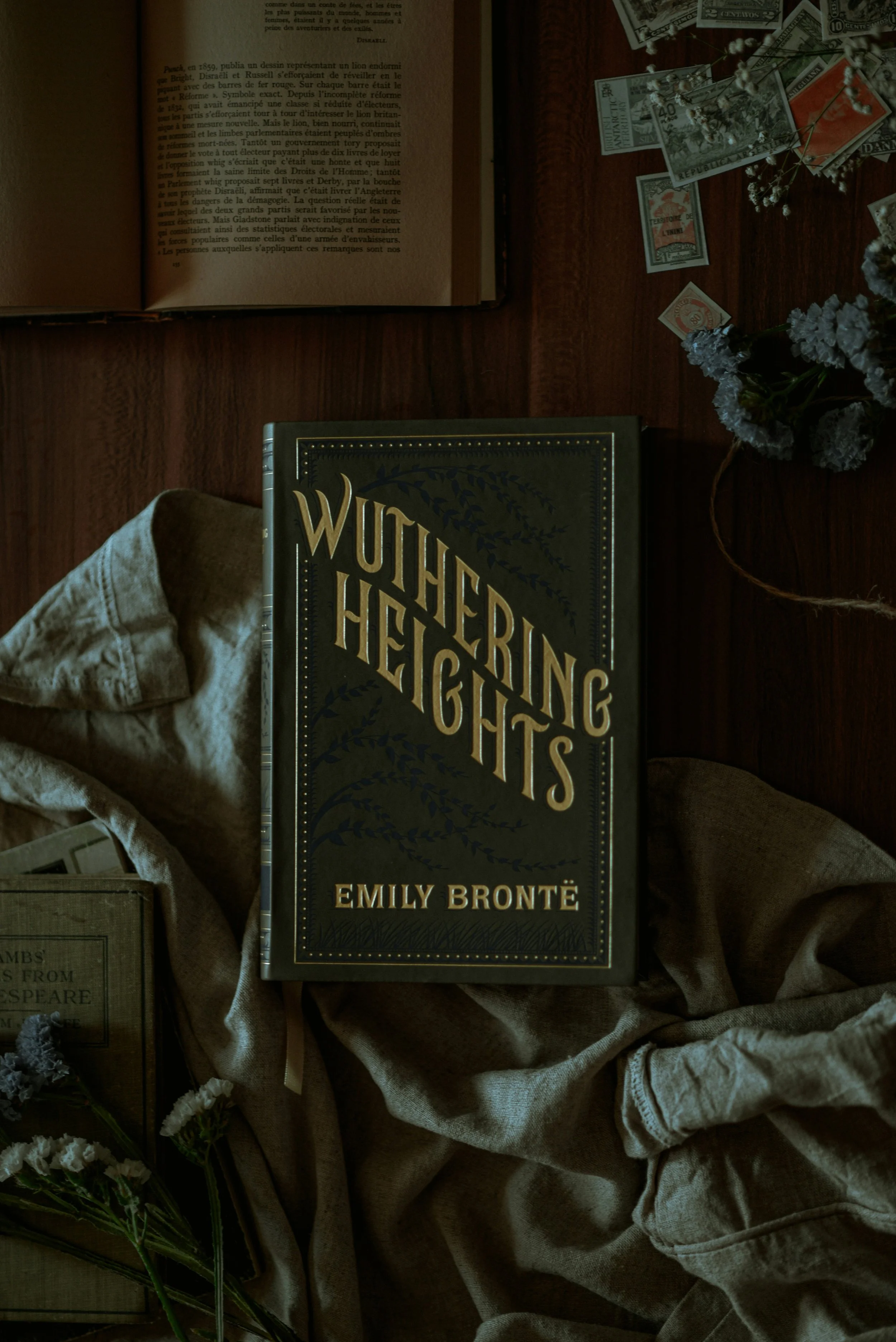
Thumbnail & Banner Photo by: Zoe on Unsplash
For the engaged reader, inserting yourself into a favourite story or reimagining a disappointing ending is as natural as breathing. In most cases, this impulse is reserved for one’s mind alone and perhaps the pages of a journal dating back to elementary school. In the case of actress and filmmaker Emerald Fennell, this journal full of preteen musings has been unleashed to the public.
Released this past Valentine’s Day, Wuthering Heights has brought forth a storm that could rival the one faced by Lockwood during his first few days at Thrushcross Grange. Uniting book lovers and ostracizing those open-minded to an aestheticized adaptation, Emerald Fennell has drawn a line between muddy Yorkshire moors and the carpeted velvet of Hollywood. Often a subject of controversy, film adaptations can cause a stir regardless of how faithful they stay to the text, conjuring up a die-hard group of book lovers to critique and compare artistic choices. Although everyone is entitled to their own opinion, one wonders how far audiences can push for textual accuracy and how much adaptations can bend until a book's integrity has been entirely dismissed. Arguably, this depends on the content and context of the original work itself. For example, there seems to have been far less outrage around the Wonka adaptation than there was for the recent Frankenstein, which faced a variety of criticisms for its alterations to the story. This is largely due to the varying approaches to each novel's content, as while Wonka maintained an air of lightheartedness which sanitized any darker themes, Guillermo del Toro dove headfirst into the essential conversations around disability and loss which permeate Shelley’s Frankenstein. Similarly, Emily Brontë intended for her seminal work to engage with equally valuable dialogues, specifically that of racism, class inequality, abuse, and unrelenting cycles of violence.
Claiming to have been “inspired by the greatest love story of all time”, a rather reductive statement put forth within the official trailer due to the source material offering far more than a meagre love story, the tone for the adaptation's controversial alterations of plot and theme is immediately made clear. For any Wuthering Heights fanatics, the trailer would come as an immediate shock to the system. Between erotic and sexually explicit, albeit beautiful, shots of Margot Robbie and Jacob Elordi, one quickly questions if they have the right trailer playing. Where are Cathy’s signature dark curls and, more importantly, Heathcliff's brown skin? In an interview with Fandango, Jacob Elordi explains that, “This is Emerald making you feel the way the book made her feel when she read it when she was younger”. Okay, sure, however, it’s important to note that Emerald Fennell is a white woman from an extremely financially privileged background in London, England. So, while Fennell is absolutely allowed to have her own takeaways from the book, how much of the love story which her thirteen-year-old self perceived needed to be shared with the world?
The concerns from critics and readers regarding casting and themes have been persistent, with those behind the adaptation being called to answer for these creative choices. Mostly, Fennell has been contesting these claims about the alterations by asserting, “What I can say is I’m making a version of it”. Arguably, this is a rather lacklustre defence for such a bold decision to make regarding the integrity of the text. When Fenell’s version of the classic book erases everything that made it and continues to make it pertinent and influential, I’d argue that it is an unnecessary contribution to the cultural zeitgeist, given how little it chooses to honour the original themes that make the book so impactful. From the trailer, the only thing that this adaptation seems to contribute is artfully shot scenes of Jacob Elordi shirtless; something you can obtain by watching Euphoria, in which Jacob Elordi also stars as a main male love interest.
Although many argue that his race is not explicitly stated by Brontë, Heathcliff is described multiple times throughout the book as “dark-skinned”, and his mother, as suggested by Nelly Dean, could be an “Indian queen”. Which sounds about as direct as it gets! The various comments about Heathcliff’s skin colour and social class are not passing remarks that have little influence on the narrative, but rather inform his entire character and much of the plot. Brought to the remote moorland farmhouse by Earnshaw, Heathcliff is an immediate outsider. He only faces poorer treatment after Earnshaw passes, and he is reduced to an abused servant. This treatment is not a random act of unkindness; it entirely stems from his ethnicity as, likely, a South Asian orphan. Heathcliff’s status as a person of colour and common labourer in late 18th to early 19th century England plays a large role in the tragedy of his lifelong yearning for Catherine. After all, Catherine mournfully relays to Nelly that she “cannot marry him due to his low social status”, a statement that causes Heathcliff to flee the farmhouse and Catherine to marry Edgar Linton. Thus, the most tragic love story of all time unfolds: a timeless story which is burdened by grim human realities that no amount of overly saturated editing and misguided casting can conceal.
If miscasting the forlorn lovers of Wuthering Heights wasn’t enough, Emerald Fennell also cast the film's two antagonists as people of colour. Shazad Latif takes on the role of Edgar Linton, a good man, but one who acts as a barrier between Catherine and Heathcliff’s toxic tension. Acting as the main narrator in the novel, Nelly Dean is played by Hong Chau, a villainized version of the infamous housekeeper and all-seeing eye. Although Fennell does not totally whitewash her film, ensuring that her main characters remained white and the villainous or rather, overlooked characters of her film are people of colour seems targeted. This is not to discount Latif and Chau, both of whom displayed incredible performances within the film, instead it is a criticism of Fennell’s clear personal biases. It seems to expose her inherent prejudice, the inability to imagine the main love interest as anything other than a conventionally attractive white man, despite clear indication that he is not. An extremely common problem within Hollywood. What could have been a diverse cast that still honoured the original text is marred by Fennell and the casting director’s unfortunate and limited vision for the film.
Regardless of the various alterations, one may argue that adaptations keep the original content alive. Thanks to Emerald Fennell, Wuthering Heights is living and breathing within popular culture, some 180 years after its initial publication. While this is true, when the original themes within the book, like Heathcliff’s race and subsequent treatment, are so applicable to our current political climate, it is all the more important to tell the accurate tale of Catherine and Heathcliff. Though the film abandons much of the text’s essential substance, there remains the hope that Emily Brontë’s talent remains visible enough to entice viewers to seek out the novel and discover its original magic.